The Paradigm Problem
In 1979, Burrell and Morgan mapped the paradigm wars that still explain why your evaluations keep failing you.
Most leaders have never encountered them.
Which is precisely the gap this article is about.
Burrell and Morgan weren’t writing about leadership or evaluation. They were mapping the sociological paradigms (the invisible frameworks of assumption) that determine what researchers treat as real and what they treat as evidence. Their argument was unsettling: that these paradigms are, to a significant degree, incommensurable. People working inside different ones aren't simply disagreeing about the data; they're starting from different assumptions about what counts as real in the first place. Kuhn had made a related point about scientific communities - that proponents of competing paradigms can look at the same thing and genuinely see something different.
Forty-seven years later, this plays out every week in the evaluation reports landing on senior leaders’ desks across the NHS, education, and the wider public sector.
You commission a rigorous evaluation. The methodology is sound. The data is clean. And the report tells you almost nothing useful about why your change programme played out the way it did - or what you should do next.
That gap isn’t a data problem. It’s a paradigm problem. And until you can see it, you can’t fix it.
Here’s what’s actually happening.
Every evaluation is built on two layers of invisible assumption. The first is ontological - what does the evaluator believe exists to be measured? The second is epistemological- what do they accept as legitimate evidence?
A positivist evaluator believes outcomes are objective facts and that valid knowledge comes from measurement and control. They build pre/ post questionnaires, aggregate scores, and report a mean effect. A constructivist evaluator believes outcomes are constituted by the meanings people make of them, and that valid knowledge requires understanding experience from the inside. They conduct interviews and report themes. A critical realist evaluator believes mechanisms exist but are triggered differently by context - so they design evaluation around explaining how and for whom, not just whether.
These aren’t different methods. They’re different answers to the question of what’s real.
The evaluator who lands on your desk has one of these positions - usually unexamined, rarely declared. And if it doesn’t match what your programme actually is, the evaluation will be competent and useless.
I first encountered Burrell and Morgan in my MA dissertation on complexity in social systems at the University of Hull, supervised by Dr Norma Romm - alongside Kuhn’s account of how scientific communities operate within self-reinforcing paradigm structures that make genuine cross-paradigm communication almost impossible.
My own work extended Burrell and Morgan’s four-paradigm matrix to five. Their original framework distinguishes between paradigms on two axes: subjective versus objective assumptions about social science, and a sociology of regulation versus radical change. But within the radical change quadrant, two fundamentally different epistemological positions were being collapsed into one. Radical humanist complexity emphasises the existence of alternative realities - multiple ways of seeing that can challenge dominant assumptions. Postmodern complexity, following Cilliers and Lyotard, makes a different and more unsettling claim: that the very search for a unifying framework (including an emancipatory one) constitutes an avoidance of complexity. The appropriate response to ubiquitous complexity is not a better theory. It is epistemic humility, and an acknowledgement of the irreducible limitations of our knowledge.
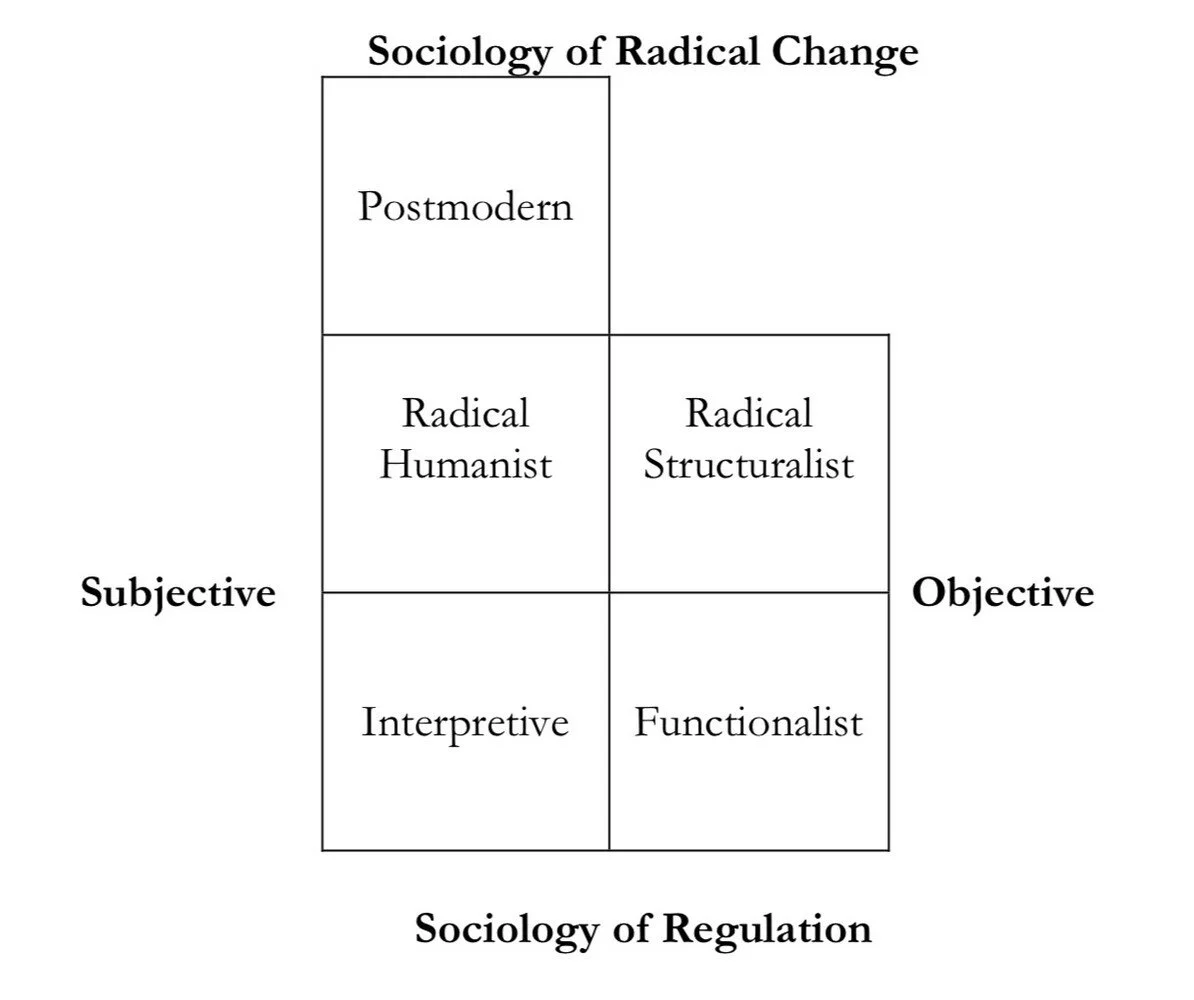
Five paradigms for the analysis of complexity in social theory (adapted from Burrell and Morgan, 1979)
That distinction matters practically. A leader who mistakes a postmodern complexity problem for a radical humanist one will keep generating alternative frameworks to explain what’s going wrong - when the actual task is to relinquish the expectation that a single framework can do the job at all.
At the time, this was intellectual architecture. It has since become one of the most practically useful lenses I work with.
It is also a lens I've been able to bring to my work in national research infrastructure. At the NIHR Research Delivery Network, I co-led the development of the Performance and Impact Framework through which the Network monitors, evaluates and learns from its performance and impact - and that framework makes a deliberate paradigmatic choice. It treats metrics as necessary but not sufficient. Rather than letting measurement stand in for understanding, it draws explicit distinctions between monitoring (tracking whether activities are on track) evaluation, defined as the analysis of how, why and for whom work brings value, and learning, the process through which that analysis actually changes future decisions. It is built on a logic model architecture, tracing inputs through activities, outputs, and outcomes to impact, so that causal or contributory traceability is designed in from the outset rather than reconstructed retrospectively. The framework describes its own approach as holistic and systemic, designed for work within a complex system - language chosen deliberately. Those are paradigmatic commitments: that explanation matters more than description, and that a complex system cannot be understood through measurement alone. In most organisations, those choices aren't made at all.
The consequences are serious. When your evaluation framework is paradigmatically mismatched with the complexity of your system, three things happen reliably.
You get description masquerading as explanation. The report tells you what happened. It cannot tell you why, because that requires a causal or contributory theory the design never specified.
You get contested findings that feel irresolvable. Different stakeholders reach different conclusions from the same data - not because someone is wrong, but because they’re working from different paradigmatic assumptions about what the data means. Better communication alone won't close that gap, because the disagreement sits beneath the level communication operates on. What it takes is surfacing the assumptions themselves - making the competing paradigms visible, so people can at least see why they're talking past each other.
You absorb strategic confusion that actually belongs one level up. Leaders internalise the problem as a failure of judgement or nerve, when the real failure was in the epistemological architecture of the evidence base they were handed.
This is where coaching enters.
In my work with senior leaders, paradigmatic assumptions are rarely where people look for the source of a strategic problem - and often where it turns out to be. The intelligence is there. The commitment is there. The evidence framework is quietly working against them - and nobody has ever named that clearly enough for them to act on it.
If this is landing for you (if you’re leading a significant evaluation, managing a performance challenge, or navigating a restructure where the evidence keeps failing to give you traction) I offer a free conversation for senior leaders.
Burrell and Morgan’s paradigm map. The incommensurability debate. The five-paradigm extension developed in my Hull dissertation. These threads run through The Performance Gap - my newsletter for leaders who want to understand what’s actually driving outcomes in their organisations. Season 2 launches Monday, focused on team dynamics. Season 3, goes deeper into organisational systems and culture. The full archive of Season 1 is at andrewantonywalker.com/the-performance-gap-archive.
If you found this useful, follow for more. And if you know a leader who needs to hear this - please share it.